
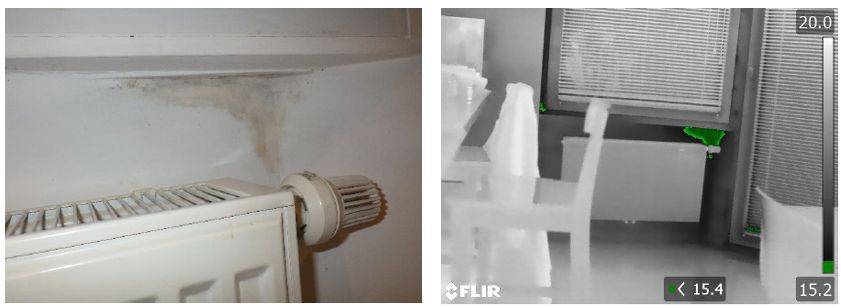
The thermal image shown at the top of this article illustrates a real-life case observed during the assessment of a property affected by mould. At first glance, the source of the problem was not clearly identifiable.
The use of a thermal imaging camera revealed a particularly cold area beneath a window. Invisible to the naked eye, this temperature difference promoted localised condensation and created conditions favourable to mould growth.
Condensation, thermal bridging, water infiltration, a leak or insufficient ventilation can produce similar symptoms while having very different causes. Accurately identifying the source of the moisture helps avoid inappropriate work, improve occupant comfort and better preserve the property's value.
Key Takeaway
A visible sign of moisture is not enough, on its own, to identify the source of the problem. A precise assessment is essential before considering any remedial work.
A Real-Life Case Observed on Site
In the case shown in the image, mould was visible on the wall beneath a window.
The thermal imaging camera revealed that this section of the wall had a surface temperature of approximately 15 °C, significantly lower than the surrounding areas.
This localised cooling increases the relative humidity immediately around the wall surface. In the situation observed, the local relative humidity could reach approximately 80%, creating particularly favourable conditions for mould growth.
What the Thermal Image Reveals
- A significantly colder area beneath the window.
- A temperature difference that would not be visible during a standard visual inspection.
- A location where moisture in the air is more likely to condense.
- A technically consistent explanation for the localised mould growth.
Without a technical assessment, this type of issue could too quickly be attributed to water infiltration, a leak or inadequate maintenance.
The case shown demonstrates that a cold area or thermal bridge can sometimes be enough to explain recurring mould growth.
Why Should Moisture Problems Never Be Ignored?
Moisture may appear to be only a cosmetic issue, but its consequences can extend far beyond a few visible marks.
According to Luxembourg's Ministry of Housing, mould develops when the material on which it grows remains damp and is unable to dry. Moisture can result from direct water penetration or from insufficient removal of humidity from the indoor air.
The Main Warning Signs
- Dark marks or mould on walls and ceilings.
- Regular condensation on windows.
- Blistering paint or peeling wallpaper.
- A persistent damp or musty smell.
- Cold wall surfaces or localised thermal discomfort.
Persistent moisture can damage finishes and certain building materials. A high concentration of mould spores can also trigger allergies or irritation, particularly among more sensitive occupants.
The earlier the source of the problem is identified, the easier it generally is to provide a targeted response and prevent the situation from worsening.
What Are the Main Causes of Moisture Problems?
Visually similar symptoms may result from very different phenomena. A solution applied without a prior assessment may therefore address only the visible consequences.
| Possible Cause | Commonly Observed Signs |
|---|---|
| Condensation | Moisture around windows, in corners or on cold wall surfaces. |
| Thermal bridge | A localised cold area that promotes condensation. |
| Water infiltration | Marks that may appear near a façade, roof or defective junction. |
| Plumbing leak | Localised moisture near water pipes, a kitchen or a bathroom. |
| Rising damp | Moisture generally visible in the lower section of a wall in contact with the ground. |
| Insufficient ventilation | Persistent indoor humidity and inadequate air renewal. |
Condensation
Condensation occurs when water vapour in the indoor air meets a surface that is cold enough.
The phenomenon is common around windows, in the corners of external walls and behind certain items of furniture where air circulation is limited.
Thermal Bridges
A thermal bridge is an area of the building envelope where resistance to heat transfer is lower than in the surrounding sections.
The internal surface temperature can therefore be lower, increasing the risk of condensation when the indoor air contains a high level of moisture.
Water Infiltration
Water infiltration may originate from a roof, façade, crack, window junction or waterproofing defect.
Its source should be located before any repairs are undertaken in order to avoid treating only the visible consequences.
Rising Damp
Rising damp mainly affects the lower sections of walls. It occurs when moisture from the ground migrates upwards through porous building materials.
Insufficient Ventilation
Showers, baths, cooking and drying laundry all produce water vapour. If this moisture is not removed effectively, it may condense on the coldest surfaces in the property.
How Does a Thermal Imaging Camera Work?
Infrared thermography makes it possible to visualise temperature differences across the surfaces of building elements.
Warmer and colder areas are represented by different colours. This makes it easier to identify anomalies that may not be visible during a conventional inspection.
What Thermography Can Help Identify
- Cold areas that may promote condensation.
- Certain thermal bridges.
- Differences in thermal behaviour between wall surfaces.
- Anomalies that require further investigation.
A thermal imaging camera is a useful analytical tool, but its images must be interpreted in light of the measurement conditions, indoor and outdoor temperatures and the building's characteristics.
A temperature difference alone is therefore not sufficient to confirm the presence of water infiltration or a structural defect.
Moisture and Energy Performance: An Often-Overlooked Connection
Cold areas revealed by a thermal assessment may sometimes indicate weak insulation or a thermal bridge.
These weak points can have two consequences: they promote condensation on internal surfaces and facilitate heat transfer through the building envelope.
Key Takeaway
A moisture problem can sometimes reveal a thermal weakness that may also affect occupant comfort and the property's heating requirements.
Moisture should therefore not be assessed in isolation from the property's ventilation, insulation and overall energy performance.
How Can Moisture Affect a Property Sale?
During a property sale, signs of moisture are among the issues most likely to raise questions from prospective buyers.
Without a documented explanation, a buyer may fear significant water infiltration, a waterproofing defect or work whose cost is difficult to estimate.
By contrast, an assessment that identifies the cause helps put the situation into context. It makes it possible to distinguish a localised issue from a building defect requiring more extensive investigation or remedial work.
The BLImmo Approach
When a property displays signs of moisture, the objective is neither to minimise nor exaggerate the problem, but to gather sufficiently precise information to understand the situation.
This technical and transparent approach helps prepare the property for sale, anticipate buyers' questions and present the property more objectively.
What Should You Do Before Selling a Property Affected by Moisture?
- Do not simply conceal visible marks with paint or a surface treatment.
- Identify the cause of the problem before deciding which work should be undertaken.
- Keep reports, photographs and invoices relating to assessments and completed work.
- Choose a lasting solution suited to the actual cause of the problem.
- Present the situation transparently to prospective buyers.
FAQ: Moisture and Property in Luxembourg
Does a Damp Mark Always Indicate a Serious Problem?
No. A mark may result from localised condensation, but it may also indicate water infiltration, a leak or another source of moisture. The cause should be identified before the seriousness of the situation is assessed.
How Can You Tell Whether a Thermal Bridge Is Encouraging Mould Growth?
A thermal imaging camera can reveal an unusually cold section of a wall. This observation should be considered alongside humidity levels, ventilation and the property's construction characteristics.
Can a Thermal Imaging Camera Detect Every Cause of Moisture?
No. Thermography primarily reveals temperature differences. It is a useful analytical aid, but some situations require additional measurements or further investigation.
Is Cleaning the Mould Enough to Solve the Problem?
Not necessarily. Cleaning removes the visible marks, but the mould may return if the source of the moisture, inadequate ventilation or the cold surface is not addressed.
Can Moisture Affect Buyers' Perception of a Property's Value?
Yes. Unexplained marks can concern prospective buyers and influence their perception of the property. A cause that has been clearly identified, documented and properly addressed enables the situation to be presented more objectively.
Should an Assessment Be Carried Out Before the Property Is Put on the Market?
When a moisture problem is visible or recurring, a prior assessment can help identify its source, determine which interventions may be useful and anticipate questions from prospective buyers.
Our Local Expertise
BLImmo assists property owners throughout Western Luxembourg, including Steinfort, Hobscheid, Koerich, Mamer, Kehlen, Capellen, Garnich, Eischen, Windhof and the surrounding municipalities.
This local market knowledge, combined with careful attention to the property's actual condition, helps position a property appropriately and anticipate the questions that may arise during its marketing.
Sources and Further Information
Are You Considering Selling a Property Showing Signs of Moisture?
Every situation is different. Understanding the cause of a moisture problem helps prepare the property for sale and present it transparently to prospective buyers.
BLImmo assists with the valuation of your property and its positioning on the Luxembourg real estate market.