
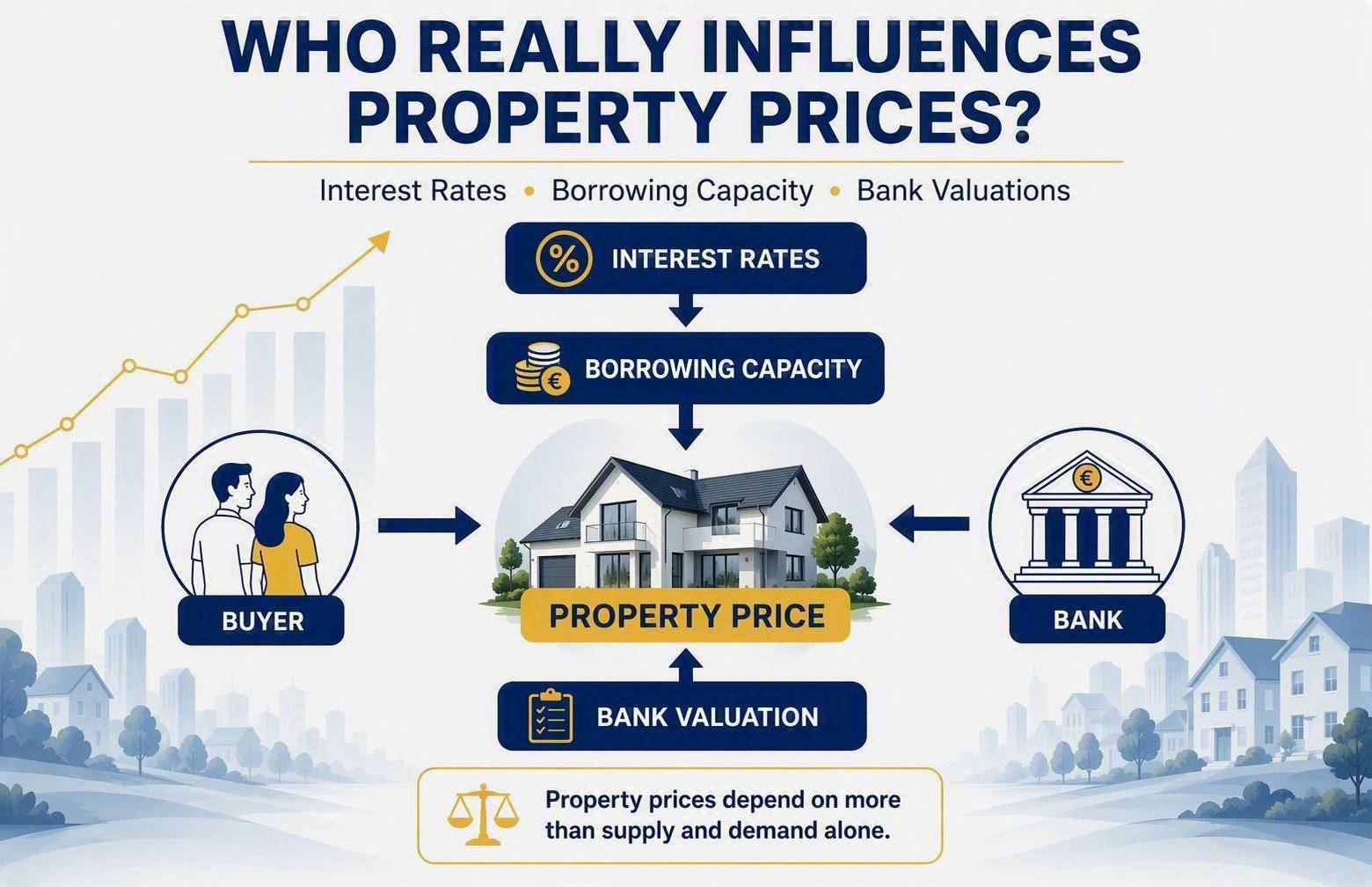
In Luxembourg, the price of a home does not depend solely on its location, condition or the seller’s expectations. Interest rates directly affect household borrowing capacity, while the bank’s assessment of the application and its valuation of the property offered as collateral may determine whether the purchase can be financed.
When interest rates rise, the same monthly repayment supports a smaller loan. When rates fall, borrowing capacity may improve, without necessarily returning immediately to the particularly favourable lending conditions seen before the increase in rates.
The property market therefore reflects a balance between the asking price, the amount accepted by the buyer, the buyer’s ability to repay and the value taken into account by the lender. Understanding these mechanisms helps sellers position their property more accurately and enables buyers to secure their purchase more effectively.
Key Takeaway
Interest rates largely determine how much a household can borrow. However, a property transaction must also be acceptable to the bank, which assesses both the buyer’s ability to repay and the value of the property offered as collateral.
Why do interest rates influence property prices?
Most property purchases are financed with a mortgage. For many households, the available budget is therefore determined not only by the price of the property, but also by the monthly repayment they can reasonably afford over twenty, twenty-five or thirty years.
With the same income, deposit and repayment period, a higher interest rate reduces the capital that can be borrowed. The buyer may then have to look for a less expensive property, increase the deposit, extend the repayment period if the bank agrees, revise the project or postpone the purchase.
The main factors affecting a buyer’s budget
- The stable income taken into account by the bank.
- Existing loans and other financial commitments.
- The monthly repayment considered affordable.
- The interest rate offered.
- The repayment period.
- The buyer’s available deposit.
- Purchase costs, insurance and any planned renovation work.
When this affects many buyers at the same time, the level of solvent demand decreases. Asking prices do not necessarily fall immediately, but marketing periods may become longer and negotiations more substantial.
A practical example of borrowing capacity
Consider a purely illustrative example in which a household can devote €3,000 per month to repaying capital and interest over thirty years.
| Illustrative nominal rate | Theoretical borrowing capacity | Difference compared with 1.5% |
|---|---|---|
| 1.5% | Approximately €869,000 | Reference |
| 3.5% | Approximately €668,000 | Approximately €201,000 less |
| 4.5% | Approximately €592,000 | Approximately €277,000 less |
These indicative calculations assume constant monthly repayments and exclude insurance, fees, the buyer’s deposit and the lending criteria applied by each bank. They do not constitute a credit offer or a personalised mortgage simulation.
Between 1.5% and 3.5%, the theoretical borrowing capacity in this example decreases by approximately 23%. At 4.5%, the reduction approaches 32%. This mathematical relationship helps explain why a rapid increase in interest rates can lead to a market correction even when household income has not fallen.
Key Takeaway
A change of only a few percentage points can represent tens or even hundreds of thousands of euros in borrowing capacity over a long repayment period. The price a buyer can afford therefore also depends on the financing conditions available at the time of the purchase.
Why do property prices not adjust immediately?
The relationship between interest rates and property prices is not instantaneous. A seller may continue to use the price achieved by a comparable property several months or years earlier as a reference. A seller who is not under pressure to sell may also prefer to withdraw the property rather than accept an offer below expectations.
Buyers also adjust their budgets gradually. Some increase their deposit, while others look for a smaller property, consider another municipality or postpone the purchase. During this adjustment period, the market may first experience fewer transactions and longer marketing periods before prices change more visibly.
Signs of a market adjustment
- Fewer buyers are able to finance the asking price.
- Properties remain on the market for longer.
- The difference between asking and agreed prices increases.
- Banks refuse more applications or request additional equity.
- Buyers become more selective about condition, location and overall quality.
Existing and new-build properties follow different dynamics
The existing-property market can adjust through negotiation between an individual seller and buyer. The owner decides whether to accept an offer according to the circumstances, future plans and level of demand. When the asking price no longer corresponds to the budgets of solvent buyers, an adjustment remains possible.
For new developments, the room for manoeuvre may be more limited. The price must cover the land, studies, building materials, labour, project financing, technical requirements, risks and the developer’s margin. A substantial reduction may therefore undermine the financial viability of the development.
Official Luxembourg statistics illustrate this difference. In the third quarter of 2025, the number of transactions involving existing homes was close to the usual levels recorded between 2017 and 2021. For apartments under construction, transaction numbers had increased over one year but still represented only around half of the average pre-crisis level.
Why the new-build market may remain under pressure
- Construction costs that are difficult to reduce.
- The developer’s own financing costs.
- A total price that is often higher than for a comparable existing property.
- The need to achieve sufficient pre-sales before construction begins.
- More restricted borrowing capacity for some households.
What is the purpose of the valuation requested by the bank?
Before granting a mortgage, a bank does not consider the borrower’s income alone. It also assesses the property that will serve as collateral. The purpose is to determine its value in a prudent and documented manner.
The European Banking Authority’s guidelines on loan origination and monitoring provide for the property used as collateral to be assessed by an internal or external valuer who meets competence and independence requirements. This does not necessarily mean that a separate independent committee must meet for every application. The exact organisation depends on the lender, its internal procedures and the characteristics of the financing.
It is also important to distinguish between the asking price, the agreed price, the estimated market value and the value taken into account by the bank in its risk assessment. These amounts may be close, but they are not automatically identical.
| Concept | What it represents |
|---|---|
| Asking price | The amount at which the seller wishes to market the property. |
| Agreed price | The amount accepted by the seller and buyer. |
| Estimated value | An opinion of value based on the property’s characteristics, the available documents and relevant market evidence. |
| Value used by the bank | The value considered in the assessment of the collateral and credit risk, in accordance with the lender’s rules. |
What happens if the valuation is lower than the purchase price?
A valuation below the agreed price does not automatically mean that the mortgage will be refused. It may, however, affect the lender’s assessment of the risk and the amount of equity required from the buyer. The decision may depend on the borrower’s profile, available deposit, the relationship between the loan amount and collateral value, other financial commitments and the lender’s own policy.
Possible consequences depending on the application
- The bank asks the buyer to provide a larger deposit.
- The amount financed is reduced.
- Additional collateral or guarantees are required.
- The proposed lending conditions become less favourable.
- The buyer attempts to renegotiate the purchase price.
- The mortgage is refused if the risk is considered too high.
The financing condition in the preliminary sale agreement should therefore be drafted carefully and reflect the financing actually required. Buyers should discuss their borrowing capacity and the structure of their application with their bank or mortgage broker before making a definitive commitment.
Key Takeaway
The fact that a buyer accepts a price does not guarantee that the bank will finance the full transaction. If the value used for the collateral is lower than the agreed price, a larger deposit or an adjustment to the purchase may be necessary.
How may a valuer assess a property?
A valuation should not be reduced to multiplying the floor area by an average price per square metre. Two properties in the same municipality may have different values depending on their precise location, surroundings, condition, floor, orientation, energy efficiency, ancillary spaces and the quality of the available documentation.
Factors that may be examined
- The precise location and immediate surroundings.
- The type, age and general condition of the building.
- The usable floor area and consistency of the documents.
- The layout, natural light and functionality.
- The energy performance certificate.
- Any work required in the short or medium term.
- Cellars, garages, parking spaces and outdoor areas.
- Known easements, rights and restrictions.
- Sufficiently recent and relevant comparable transactions.
Average prices provide useful reference points, but they do not replace an individual analysis. The Luxembourg Housing Observatory itself specifies that its municipal price ranges are indicative and do not amount to a professional valuation.
Who really determines the price of a property?
No single participant can determine the final price alone. The seller chooses the asking price, but the buyer decides how much to offer. The estate agent advises on market positioning by considering the property, available documents, comparable evidence and observed demand. The bank decides whether it will finance the transaction and under which conditions.
| Participant | Role in the formation of the price |
|---|---|
| Seller | Sets the asking price and decides whether to accept an offer. |
| Buyer | Offers an amount considered appropriate and potentially financeable. |
| Estate agent | Analyses the property and recommends suitable market positioning. |
| Valuer | Provides an independent opinion of value within the scope of the assignment. |
| Bank | Decides on the financing according to the borrower, collateral and its risk policy. |
| Market | Reflects the balance between available supply and genuinely solvent demand. |
The transaction price emerges when these different constraints become compatible. A price may appear satisfactory to the seller and acceptable to the buyer, but still prove difficult to finance. Conversely, a well-positioned and properly documented property that is consistent with market evidence may facilitate the decisions of all parties.
What can a seller do before marketing the property?
A seller cannot control interest rates or a bank’s internal lending rules. However, uncertainty can be reduced by preparing the property file carefully and choosing a price that reflects the property’s actual qualities and relevant comparable transactions.
Preparing a stronger property listing
- Gather the relevant plans, permits, deeds and co-ownership documents.
- Keep invoices and supporting documents for completed renovations.
- Check that the visible situation is consistent with the available documents.
- Identify any work or restrictions likely to affect the value.
- Compare the property with genuinely relevant market evidence.
- Avoid an excessive initial price that could leave the property on the market and weaken buyers’ perception of it.
The BLImmo Approach
A property valuation should not be based solely on a general average or the amount hoped for by the owner. It should reflect the local market, the property’s technical characteristics, the condition of the building, the available documentation and the financing environment faced by potential buyers.
This structured approach helps explain the proposed price, anticipate questions and reduce the risk of a significant inconsistency being discovered late in the process, particularly during the buyer’s financing application.
Value before you market
At BLImmo, we analyse the property, its surroundings, the available market evidence and the documents that may influence its value.
The objective is to recommend a well-supported position that the seller can understand and that remains consistent with solvent demand in the local market.
FAQ: Interest Rates, Financing and Property Prices in Luxembourg
Does a reduction in interest rates automatically increase property prices?
No. Lower rates may improve borrowing capacity and support demand, but prices also depend on income, household confidence, available deposits, housing supply, taxation and banks’ lending criteria.
Why does a higher interest rate reduce borrowing capacity?
With the same monthly repayment and loan term, a larger share of the repayment covers interest. The amount of capital that can be borrowed is therefore lower.
Does the price accepted by the buyer necessarily represent the value of the property?
Not necessarily. The price results from an agreement between the parties. An estimated value is based on an analysis of the property and market within a defined framework. The agreed price and estimated value may therefore differ.
Is the bank required to finance the price stated in the preliminary sale agreement?
No. The bank remains free to approve or refuse the financing according to its assessment of the borrower’s ability to repay, the collateral and the overall risk. The agreement between the seller and buyer does not oblige the lender to finance the agreed amount.
Does a lower valuation automatically result in a mortgage refusal?
No. It may lead to a request for a larger deposit, a lower loan amount, additional guarantees, different lending conditions or a refusal. The outcome depends on the full application and the bank’s policy.
Must the bank always send a valuer to visit the property?
The permitted valuation methods depend on the applicable framework, the type of property and the lender’s procedures. An internal or external valuer may be involved and, in certain circumstances, regulated methods or models may be used. The bank is responsible for complying with the requirements applicable to its assessment.
Why is an average price per square metre not sufficient?
An average does not reflect every difference between properties, including the precise location, condition, floor, orientation, energy efficiency, ancillary spaces, required work and documentation. It is a reference point rather than an individual valuation.
Who should a buyer contact about mortgage financing?
A buyer should contact banks and mortgage brokers to assess borrowing capacity, compare potential financing structures and understand the conditions that may apply to the purchase.
How can financing difficulties be reduced during a sale?
The seller can prepare a complete property file and choose a price consistent with the market. The buyer can have the financing capacity assessed by banks or mortgage brokers before making a commitment and ensure that the preliminary sale agreement contains an appropriate financing condition.
Our Local Expertise
BLImmo assists property owners and buyers in western Luxembourg, including Steinfort, Hobscheid, Koerich, Mamer, Kehlen, Capellen, Garnich, Clemency, Eischen, Windhof and the surrounding municipalities.
Our approach combines knowledge of the local market, technical property analysis and careful examination of the available documents so that each property can be presented consistently and transparently.
Sources and Further Information
- Central Bank of Luxembourg: interest rates applied by credit institutions
- Luxembourg Housing Observatory: property-market publications and statistics
- Luxembourg Housing Observatory: residential sale prices by municipality
- European Banking Authority: Guidelines on loan origination and monitoring
- EUR-Lex: Directive 2014/17/EU on residential mortgage credit
This article provides general information. Lending conditions, valuation methods and financing decisions vary between lenders and individual applications. For an assessment of a specific financing project, buyers should contact banks or mortgage brokers.
Would you like to know the value of your property?
A coherent valuation is not based solely on an average price per square metre. The property’s technical characteristics, documentation, local market and the borrowing capacity of potential buyers should also be considered.
BLImmo can assist with the analysis of your property and its positioning in the local market.