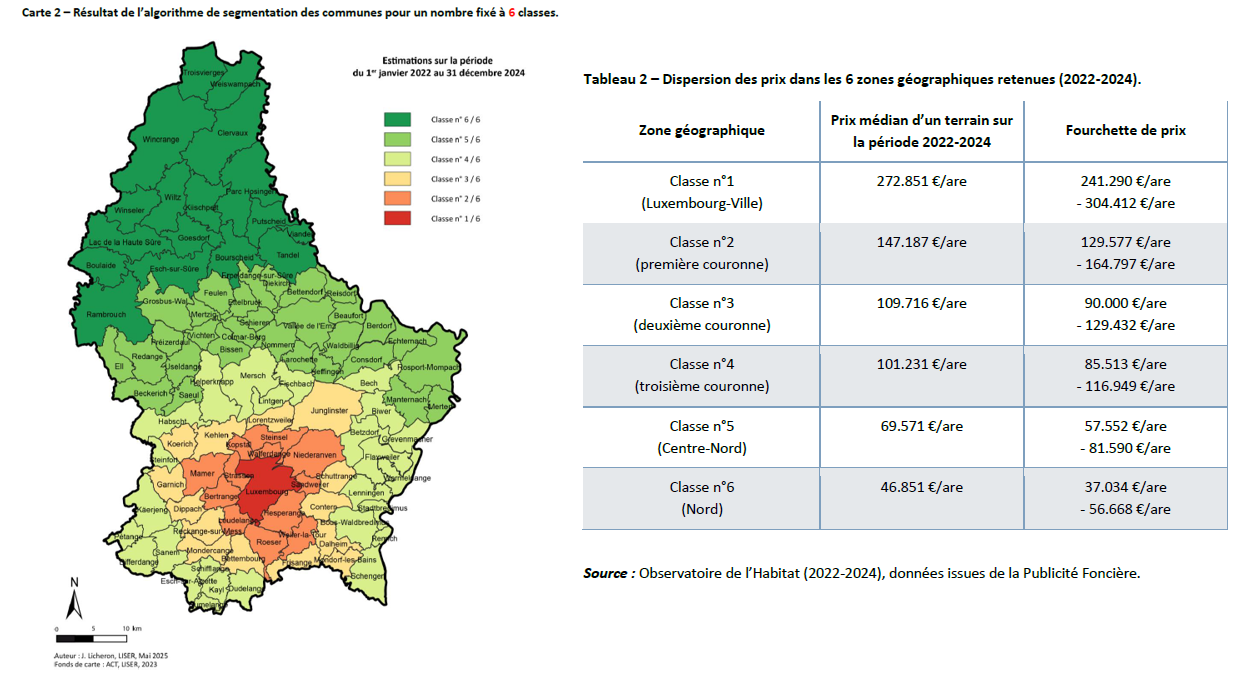
National statistics help track market trends, but the true value of a plot depends primarily on its exact location, permitted development potential and the specific characteristics of the property. An individual valuation remains essential before putting land on the market.
When selling or purchasing land in Luxembourg, one question always arises: what is the plot really worth?
Data published by the Luxembourg Housing Observatory provides a valuable overview of the market. It clearly shows that prices can vary significantly from one region to another and highlights the importance of geographical location when determining land value.
However, even two plots located within the same municipality can display substantial differences in value. Understanding these variations requires a closer look at several additional factors.
Unsurprisingly, location is generally the first criterion considered when estimating the value of land.
Plots located near Luxembourg City or within highly sought-after municipalities tend to benefit from stronger demand. In western Luxembourg, areas such as Mamer, Capellen, Steinfort, Kehlen, Koerich, Garnich and Hobscheid each have their own market dynamics, which can create noticeable differences in land values.
Beyond the municipality itself, the immediate surroundings also play a significant role, including road access, public transport links, schools, local amenities, potential nuisances and the overall quality of the living environment.
The size of a plot alone is not enough to determine its value.
Urban planning regulations can have a significant impact on price. A plot that allows the construction of a detached house, a semi-detached property, an apartment building or offers subdivision potential will not have the same value as a parcel affected by more restrictive planning rules.
Before any transaction, it is advisable to review the applicable PAG (General Development Plan) and, where relevant, the PAP (Special Development Plan) governing the area.
Even when two plots are located on the same street, several factors can justify substantial differences in value.
These factors are often decisive for developers, builders and private buyers planning a specific project.
Vacant land does not automatically have the same value as a plot on which a building already exists.
In many cases, buyers are looking for the freedom to design and develop their own project. Where a building is already present, it may limit future possibilities or require additional renovation or demolition work.
This is why the value of developed land cannot usually be calculated simply by multiplying the land area by an average market price.
Official data published by public institutions provides an excellent snapshot of the Luxembourg property market.
These statistics offer a valuable benchmark but should always be complemented by an individual assessment that takes into account the property's exact location, applicable planning regulations and local market conditions.
Every plot is unique and deserves a detailed analysis before any sale, purchase or investment decision.
| Factor | Impact on Value |
|---|---|
| Wide frontage | ⬆ Generally increases value |
| Subdivision potential | ⬆ Strong value enhancement potential |
| Favourable orientation | ⬆ Improved attractiveness |
| Easy access to transport and amenities | ⬆ Typically increases value |
| Restrictive easements | ⬇ May reduce value |
| Flood risk or significant nuisances | ⬇ Potentially negative impact |
| Major planning restrictions | ⬇ Reduced development potential |
A reliable valuation requires analysing several factors, including location, plot size, frontage width, applicable planning regulations, development potential and local market conditions.
No. Two plots of identical size may have significantly different values depending on their configuration, orientation, accessibility and permitted development opportunities.
It is important to review the applicable planning documents, particularly the General Development Plan (PAG) and, where relevant, local regulations or Special Development Plans (PAP).
Yes. The PAG defines development opportunities, planning restrictions and land use designations. These factors can have a direct impact on the property's value.
Not necessarily. However, vacant land often offers greater flexibility for buyers to design and develop their own project, which can represent a considerable advantage in certain situations.
Yes. A wider frontage generally makes development easier and may improve both the property's development potential and its attractiveness to buyers.
Official statistics provide an excellent market benchmark but can never replace an individual assessment that considers the specific characteristics of the property.
Land values can vary considerably between municipalities. In western Luxembourg, significant differences can often be observed between areas such as Mamer, Capellen, Steinfort, Kehlen, Koerich, Garnich and Hobscheid.
Yes. Environmental restrictions, natural risks and certain easements may limit development possibilities and have a negative effect on value.
A professional valuation takes into account all relevant technical, planning and market-related factors, providing a realistic estimate aligned with local market conditions.
The information presented in this article is based in particular on data and publications from the following organisations:
BLImmo assists owners with the valuation of building plots and developed land throughout western Luxembourg. A personalised assessment helps determine the full potential and market value of your property.
Request a ValuationThis site is protected by reCAPTCHA and the Google Privacy Policy and Terms of Service apply.
